

Where are the services?
- Nite Tanzarn
- 2 days ago
- 6 min read

This series has traced how women are taxed through unpaid care, depleted time, unavoidable consumption, and economic invisibility. It has shown how tax systems extract from lives already carrying the work of sustaining households and communities. This essay turns to the other side of taxation.
What happens after taxes are collected?
Tax justice is measured not only by what the state takes. It is measured by what taxation gives back.
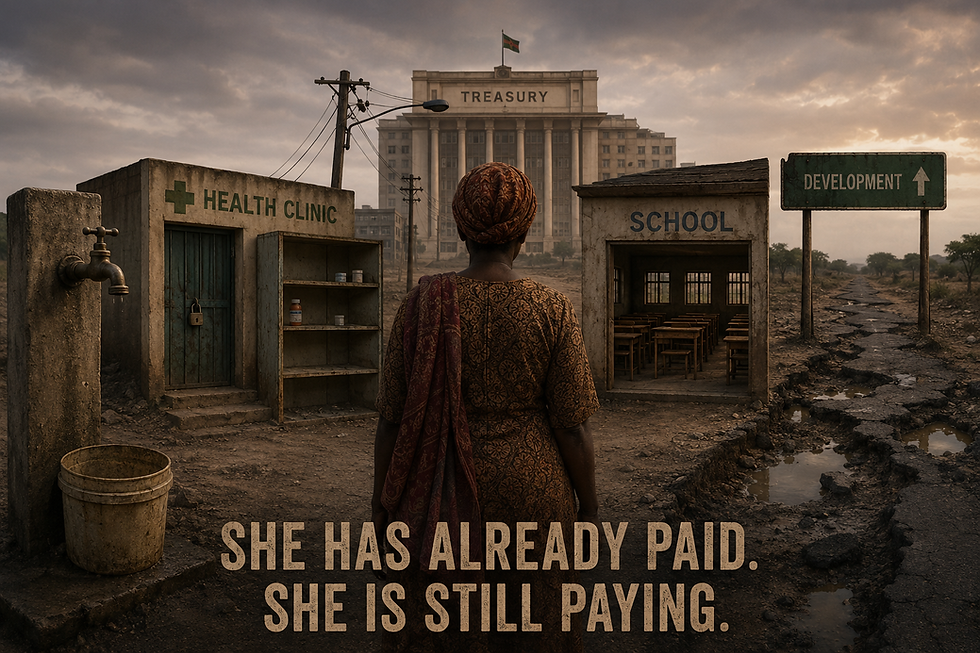
The cost of sustaining life
Living has costs.
Water has a cost. Healthcare has a cost. Education has a cost. Transport has a cost. Electricity has a cost. Sanitation has a cost.
Children cannot be educated without teachers, classrooms, books, and safe journeys to school. Illness cannot be treated without health workers, medicines, equipment, and functioning facilities. Water does not arrive by itself. Roads do not maintain themselves. Electricity does not reach homes without investment.
The question has never been whether these costs exist.
The question is who carries them.
What taxation changes
The costs of sustaining life do not disappear. Someone must secure water. Someone must educate children. Someone must care for the sick. Someone must maintain sanitation. Someone must make mobility possible. Someone must generate and distribute energy. These responsibilities exist in every society. Taxation does not remove them. It determines how they are organised.
Through taxation, societies collectively finance public systems that assume part of these responsibilities. Water systems reduce the work of obtaining water. Healthcare reduces the work of caring for illness. Schools reduce the work of educating children. Roads reduce the work of moving people and goods. Electricity reduces the work of powering homes, businesses, and public institutions. This is the fiscal bargain.
A functioning tax system does more than raise revenue. It reduces the financial costs, unpaid labour, time, and opportunities that individuals would otherwise expend simply to sustain everyday life.
When public systems fail, those responsibilities do not disappear.
They are transferred back.
Not to governments.
Not to institutions.
To people.
And because responsibility for sustaining everyday life is not equally shared, neither is the burden of replacing what public systems fail to provide.
The taxpayer who waits for the state
Tax debates often imagine the taxpayer as a formal employee whose contribution is measured through payroll deductions.
Tax systems tell a different story.
A rural household pays VAT on food, fuel, soap, clothing, school supplies, medicine, and household goods. Farmers pay taxes embedded throughout production and consumption. Small traders pay taxes, fees, and levies through everyday economic activity.
They are taxpayers. Yet many contribute while living beyond reliable public provision. No electricity grid. No piped water. Poor roads. Distant health facilities. Under-resourced schools. Limited public transport.
The question is not whether rural citizens contribute. They do.
The question is whether public investment returns to the communities that finance it.
A woman's day
She has a tap. The water does not always come.
When it does not, she buys from a vendor. She pays more per litre. She stores water in containers. She spends time managing uncertainty. She plans her day around availability. She carries what the system fails to deliver.
She has a clinic. The building stands. The sign says “Health Centre III”.
Inside, there are no drugs. The nurse has not been paid. The ambulance has no fuel. The bed has no mattress.
She walks. She waits. She is told to go to the pharmacy. She pays for medicine she cannot afford. She pays for transport to a better facility. She loses income.
She has a school. Education is officially free.
But there are fees. Uniforms. Exercise books. Development contributions. Parent association charges. Examination fees. Supplementary learning materials. Teachers may be unpaid. Classes may be overcrowded.
She pays. She pays because her daughter must learn. She pays because the state does not provide what it promised. She pays because the alternative is a child who cannot read.
She has a road. It is paved. It was paved five years ago. It has not been repaired since.
The rains come. The road floods. The road breaks. The road becomes impassable.
She pays for transport when she can afford it. She pays for delays when she cannot. She pays for vehicle repairs when the road damages the car. She loses time. She loses goods. She loses income.
She has electricity. The grid reaches her home. The poles are standing. The wires are connected.
But the power is intermittent. It cuts out without warning. It stays off for hours. It spoils food. It disrupts work. It costs her income.
She pays for a generator. She pays for fuel. She pays for spoiled food. She loses income when she cannot work.
She has already paid through taxation. She now pays for alternatives. She pays with time. She pays with labour. She pays with her body.
The infrastructure exists. The service does not.
Infrastructure is not service
A building is not healthcare. A classroom is not education. A road is not mobility. Water pipes are not water. Electricity lines are not reliable power.
Infrastructure creates possibility. Functioning institutions create public service.
Taxpayers finance both. Tax justice depends on whether both are delivered.
The clinic was constructed. The drugs were not stocked. The school was opened. The teachers were not paid. The road was paved. It was not maintained. The grid was connected. The power was not reliable.
The state built the infrastructure. The state did not fund its operation.
Taxes paid for the construction. Taxes did not pay for the service.
When public provision fails
Public failure takes different forms. Sometimes infrastructure never reaches communities. Sometimes infrastructure exists but essential services do not. Sometimes services function poorly. Sometimes services exist but remain inaccessible because of distance, cost, unreliability, or limited capacity.
The result is remarkably similar. Households compensate. The burden shifts from institutions to families. The adjustment is rarely gender neutral.
The double payment burden
A functioning tax system reduces private costs. A failing one reproduces them.
She pays taxes. She pays for private healthcare. She pays for water. She pays for transport. She pays school-related costs. She pays for alternative energy. She pays again with unpaid labour. She pays again with time.
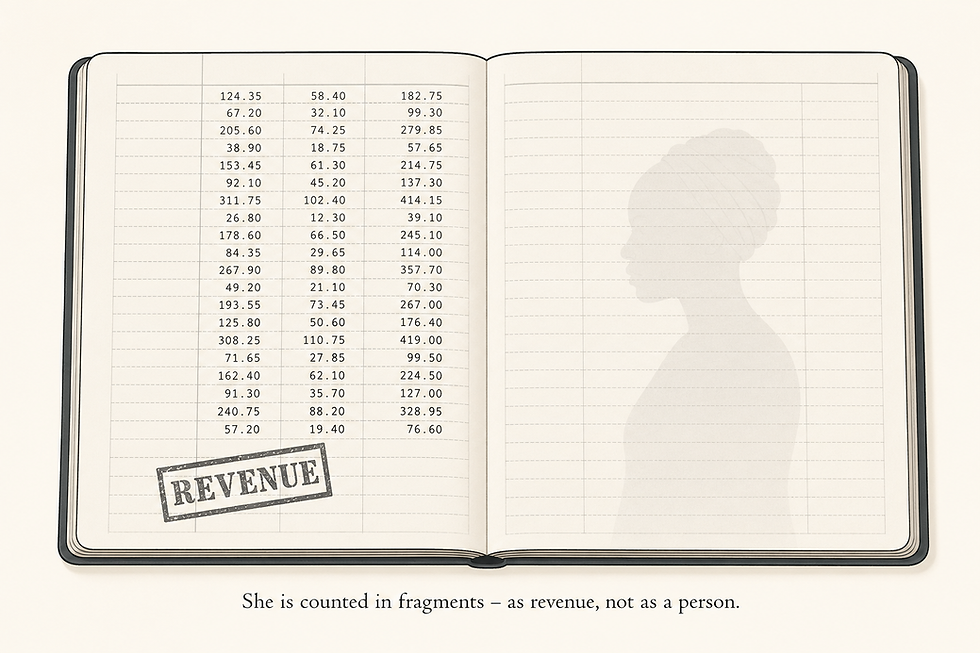
The first payment enters public revenue. The second payment never appears in public accounts. The third payment—her labour—remains invisible altogether.
This is the double payment burden. Taxation is followed by private substitution. Public failure becomes household financing.
The care tax created by public gaps
Every service gap expands unpaid care.
When water systems fail, someone collects water. When healthcare fails, someone provides care. When transport fails, someone spends more hours travelling. When childcare is unavailable, someone remains home.
That someone is disproportionately a woman.
Public systems determine the size of the care tax. Where services function, unpaid labour contracts. Where services fail, unpaid labour expands. The care tax grows not because care changes. Because public provision does not.
The time tax created by institutional failure
Functioning services save time. Failing services consume it.
Waiting. Travelling. Queueing. Returning. Searching for alternatives. Repeating journeys.
Time transferred to compensate for institutional failure becomes another unpaid tax. For women already carrying unpaid care responsibilities, these hours further reduce opportunities for paid work, education, leadership, rest, and participation in public life.
The return on taxation
Revenue collection tells only half the story. The other half asks what taxation makes possible.
Does public investment reduce unpaid labour? Does it reduce time poverty? Does it reduce the need for households to purchase private substitutes? Does it expand economic opportunity? Does it enable citizens to live with greater dignity?
These are tax justice questions.
The question that remains
She pays taxes. She pays for alternatives. She pays with time. She pays with care. She pays with lost opportunities.
The state records the first payment. The second is rarely measured. The third is almost never recognised.
The question is no longer how much tax was collected. The question is whether taxation reduces or reproduces the unequal costs of sustaining life.
A tax system cannot be judged only by what it takes. It must also be judged by what it returns.
Next: How Tax Revenue Is Used — budgets, public spending priorities, gender-responsive budgeting, and why tax justice depends not only on how revenue is raised, but also on where it goes. The double payment burden

Comments