

What is not counted does not count
- Nite Tanzarn
- 1 day ago
- 4 min read

This series has traced how care, time, and consumption are extracted through systems that depend on what they do not measure. Now we ask: what does taxation choose to see – and what does it erase?
What is not counted does not count.
The woman who is not in the register
She wakes before dawn. She fetches water. She cooks. She cleans. She cares for children and the sick. She works in the market. She returns. She repeats.
She has no Tax Identification Number. She files no return. The system does not recognise her as a taxpayer.
But she pays.
VAT on food, soap, cooking oil, sanitary pads. Excise duty on fuel. Tariffs on imported goods. Market fees, transport levies, charges embedded in every purchase.
The system records her payments as revenue. It does not record her as a contributor.
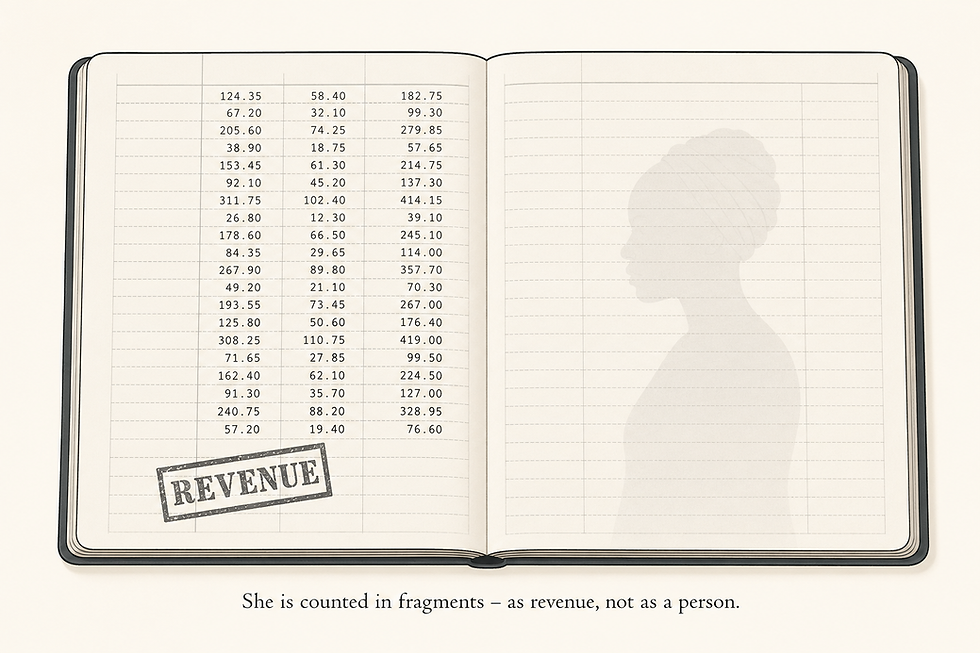
She is counted in fragments – as a consumer, as a payer of VAT, as a source of fees. She is not counted as an economic subject.
What is left out of the numbers is left out of policy.
What tax systems measure
Tax systems do not measure value. They measure what is formally declared, registered, and documented.
They measure formal wages and salaries. They measure declared business profits. They measure registered property and assets. They measure transactions that leave a digital or paper trail.
These measurements determine who is a taxpayer, what is taxable, and who bears the burden.
What falls outside these categories is not measured. What is not measured is not recognised. What is not recognised is not redistributed.
This is not a technical problem. It is a design choice.
The boundary of fiscal recognition
Tax systems inherit their boundaries from national accounting and labour classification systems. GDP measures monetised production. Labour statistics measure recognised employment. Tax systems measure what those systems have already defined as economic activity.
Cooking, cleaning, caregiving, subsistence farming – these fall outside when they are not monetised. They are economically necessary. They are fiscally unrecognised.
This is not omission. It is boundary‑making. The system does not fail to see care work. It defines care work outside what counts as taxable contribution.
What is not classified does not enter fiscal systems.
What tax systems do not measure
Unpaid care work is not in the tax base. Subsistence farming is not in the tax base. Informal trade is partially visible at best. Cash transactions are largely invisible.
But the absence of measurement does not mean the absence of contribution. The economy depends on this labour. Workers can participate in formal employment because someone has already performed the work of survival. Labour markets function because care work has already been absorbed.
The taxable economy is built on labour that is not tax‑recognised.
Yet taxation reaches into this space indirectly – through consumption.
The system depends on what it does not count.
Classification as tax power
Classification determines economic existence in taxation.
What is classified as income becomes taxable. What is classified as employment becomes reportable. What is classified as a business becomes assessable. What is classified as consumption becomes indirectly taxed.
What is not classified does not enter fiscal systems.
Unpaid care labour remains outside classification as taxable contribution. Informal provisioning remains outside formal revenue systems. Reproductive labour remains outside fiscal recognition.
This is not technical administration. It is fiscal design.
Classification decides who is taxed, how they are taxed, and what is recognised as contribution.
The invisible taxpayer
She is absent from the taxpayer register. No TIN. No return. No formal recognition as a fiscal subject.
Yet she is continuously taxed.
VAT on food. Excise on fuel. Tariffs on basic goods. Transport levies. Market fees. Consumption‑based charges embedded in survival.
The system records her payments as revenue. It does not record her as a contributor to the system that generates that revenue.
She is visible only at the point of payment, not at the point of production.
She is counted in fragments – as revenue, not as a person.
The fiscal architecture of exclusion
Tax systems do not operate independently of measurement systems. They inherit their boundaries.
Together, national accounting, labour statistics, and tax registers produce a narrow fiscal field: formal income is visible, informal labour is partially visible, unpaid labour is structurally invisible.
This shapes taxation and redistribution.
What is outside recognition is outside fiscal relief – even when it sustains the taxable economy itself.
Women who are not in tax registers still pay VAT. They still pay market fees. They still pay levies. They are visible as revenue sources but invisible as contributors.
What is not counted cannot be claimed. What is not claimed cannot be redistributed.
What counting would change in taxation
If her payments were attributed to her, she would have a record. A history of market fees, VAT payments, and levies linked to her name. That record could prove her economic existence. It could unlock credit, pensions, and recognition.
If unpaid care work were recognised as contribution, she would have claims. Not as charity – as repayment for labour already performed.
If tax authorities collected gender‑disaggregated data properly, policy would have to respond. The “Unknown” gender category in VAT revenue – up to 97.7% in Uganda – is not a technical glitch. It is a policy failure.
Counting does not automatically redistribute. But it determines whether inequality is visible enough to be addressed.
What is counted can finally be claimed.
The question that remains
She wakes before dawn. She fetches water. She cooks. She cleans. She cares. She works. She repeats.
The system does not count her care. It does not count her as a taxpayer. It counts her VAT. It counts her market fees. It counts her when she pays.
She is counted in fragments – as revenue, not as a person.
The question is not whether she contributes. She does. Every day. Every hour. Every act.
The question is whether the system will ever measure what it already depends on – and whether, once measured, it will finally account for her.
What is not counted does not count. But what is counted can finally be claimed.
Next: Where Are the Services? – missing healthcare, childcare, water, transport, and the transfer of cost onto women’s labour.


Comments