

How problems become problems
- Nite Tanzarn
- 2 hours ago
- 15 min read

Recognition, diagnosis and the roots we refuse to uproot.
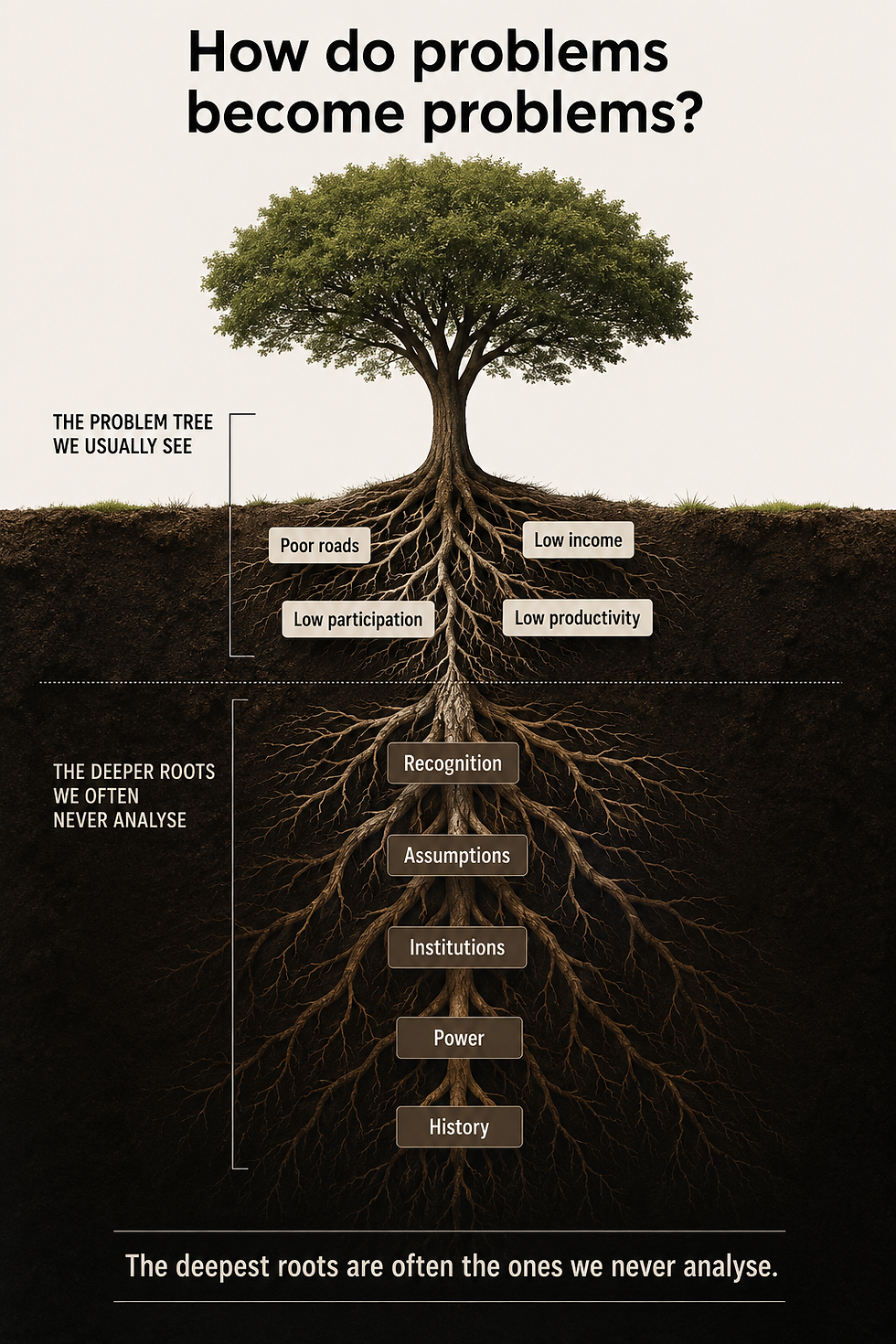
Every development intervention begins long before the first dollar is spent.
It begins long before the baseline survey, the feasibility study, the logical framework, the theory of change or the implementation plan.
It begins with a decision so fundamental that it is rarely recognised as a decision at all.
Someone decides what the problem is.
Everything that follows inherits that decision.
The evidence that will be collected.
The expertise that will be assembled.
The questions that will be asked.
The indicators that will be measured.
The funding that will be mobilised.
The intervention that will be implemented.
The evaluation that will determine success.
Development likes to present problems as though they exist independently, waiting to be discovered.
They do not.
Floods exist.
Illness exists.
Conflict exists.
Unemployment exists.
Crop failure exists.
But the problem is never self-evident.
It is always interpreted.
And interpretation begins with recognition.
This essay is not about solving problems.
It is about something more fundamental.
How do problems become problems?
Because once a particular understanding of reality becomes accepted as the problem, every subsequent solution can be technically excellent while conceptually misplaced.
Recognition comes before diagnosis
Previous essays in this series have argued that recognition determines what becomes visible.
We recognise certain forms of knowledge.
We recognise certain forms of evidence.
We recognise particular realities while overlooking others.
The same principle applies to problems.
We cannot diagnose what we have not first recognised.
Recognition always precedes diagnosis.
If unpaid care is invisible, it cannot become part of the diagnosis.
If unequal control over assets is invisible, it cannot become part of the diagnosis.
If market power is invisible, it cannot become part of the diagnosis.
If political exclusion is invisible, it cannot become part of the diagnosis.
The diagnosis can never include realities that were excluded at the moment of recognition.
This is why two competent professionals can observe the same situation and reach entirely different conclusions.
Imagine standing in the middle of a city paralysed by traffic.
One planner sees too many private vehicles.
Another sees inadequate public transport.
A third sees poor urban planning.
A fourth sees housing policies that force people to commute long distances.
A fifth sees land speculation.
A sixth sees governance failure.
Everyone is looking at the same congestion.
No one is looking at the same problem.
Each diagnosis emerges from a different recognition of reality.
Each diagnosis generates a different intervention.
Build more roads.
Expand public transport.
Change zoning regulations.
Increase housing density.
Introduce congestion charges.
Improve metropolitan governance.
The intervention is never independent of the diagnosis.
The diagnosis is never independent of recognition.
The sequence is always the same.
Recognition.
Diagnosis.
Intervention.
If recognition is incomplete, diagnosis becomes incomplete.
If diagnosis is incomplete, intervention cannot fully address the reality that produced the condition.
Diagnosis creates intervention
Development often describes interventions as responses to objective needs.
In practice, interventions respond to diagnoses.
And diagnoses respond to particular ways of understanding reality.
This distinction matters enormously.
Consider poverty.
If poverty is recognised primarily as insufficient income, diagnosis immediately focuses on earnings.
Solutions become predictable.
Income-generating activities.
Microcredit.
Cash transfers.
Skills training.
Employment programmes.
Each intervention makes perfect sense.
Provided low income is indeed the problem.
But what if income is merely the visible manifestation of something deeper?
Suppose the underlying reality is unequal ownership of productive assets.
Suppose households have no secure access to land.
Suppose markets are controlled by a few powerful actors.
Suppose political influence determines who receives irrigation, electricity, extension services or public investment.
Income then becomes an outcome rather than a cause.
The diagnosis changes.
And so must the intervention.
The same condition can produce entirely different responses depending on what has first been recognised.
Development often debates whether interventions work.
It debates far less often whether the diagnosis itself began from the right understanding of reality.
When the wrong problem grows a perfect tree
Development possesses an impressive analytical tool.
The problem tree.
Almost every development practitioner has drawn one.
The trunk represents the problem.
Branches represent consequences.
Roots represent causes.
It is elegant.
Logical.
Structured.
It encourages deeper thinking.
Provided one question has already been answered correctly.
Is the trunk actually the problem?
That question is asked remarkably rarely.
Once the trunk has been accepted, the exercise becomes increasingly sophisticated.
Participants identify immediate causes.
Underlying causes.
Root causes.
Effects.
Long-term consequences.
The analysis becomes richer and richer.
Yet every branch and every root still grows from the original definition of the problem.
If the trunk is misplaced, the entire tree becomes intellectually impressive while remaining conceptually wrong.
Development rarely fails because it cannot analyse.
Development often fails because analysis begins from the wrong starting point.
An incorrect problem tree is not an analytical failure.
It is a recognition failure.
The roots may be perfectly mapped.
They simply belong to the wrong tree.
That distinction explains why many interventions appear logical, evidence-based and technically rigorous yet repeatedly fail to transform the realities they were designed to change.
Symptoms become problems
One pattern appears repeatedly across development practice.
Conditions produced by deeper structural realities gradually become redefined as problems in their own right.
Symptoms become diagnoses.
Diagnoses become interventions.
Interventions treat symptoms.
The structures that produced them remain intact.
The cycle begins again.
This pattern appears everywhere once one starts looking for it.
Roads.
Gender.
Poverty.
Taxation.
Agriculture.
Employment.
Climate adaptation.
Health.
Education.
Different sectors.
The same intellectual pattern.
Development does not intentionally ignore root causes.
Rather, the symptom gradually becomes institutionalised as the problem itself.
Once institutionalised, enormous technical effort is invested in solving it.
Technically correct.
Conceptually incomplete.
The consequence is predictable.
Projects succeed.
The problem survives.
Symptoms, structures and the roots we refuse to uproot
Once symptoms become recognised as problems, interventions follow almost automatically.
The intervention often appears sensible.
Evidence supports it.
Experts recommend it.
Funding is secured.
Implementation begins.
Progress is measured.
Targets are achieved.
The programme is declared successful.
Yet the condition that gave rise to the intervention often remains remarkably unchanged.
Not because the intervention failed.
Because it addressed the problem it had defined.
Unfortunately, that was not the reality that produced the condition in the first place.
This distinction explains why development repeatedly appears successful while simultaneously confronting the same challenges decade after decade.
Consider roads.
A community is described as isolated.
The diagnosis seems obvious.
Poor access.
The intervention follows naturally.
Build roads.
Roads matter.
Roads connect people.
Roads reduce travel time.
Roads lower transport costs.
Roads make schools, clinics and markets easier to reach.
Few would question their importance.
But roads do not automatically change who controls markets.
They do not determine who sets prices.
They do not determine who owns transport.
They do not determine who captures value along the supply chain.
They do not determine who has access to credit, storage or market information.
The road changes movement.
It does not necessarily change power.
If the deeper reality is unequal market power, the intervention may improve physical access while leaving economic relationships almost untouched.
The road succeeds.
The original diagnosis succeeds.
Yet poverty remains.
Development often concludes that more roads are needed.
The possibility that the wrong problem was being solved receives far less attention.
The same intellectual pattern appears in agriculture.
Farmers are not adopting improved technologies.
Immediately the diagnosis begins.
Lack of knowledge.
Resistance to innovation.
Limited awareness.
Extension services expand.
Training programmes multiply.
Demonstration plots are established.
Farmers attend.
Some adopt.
Many do not.
Development asks why adoption remains low.
Only gradually does another reality emerge.
The improved seed requires fertiliser.
Fertiliser requires credit.
Credit requires collateral.
Collateral requires land ownership.
Land ownership is insecure.
Markets are unreliable.
Prices fluctuate unpredictably.
Extension advice cannot eliminate structural uncertainty.
The issue was never knowledge alone.
The intervention addressed the symptom that had first been recognised.
The structures shaping farmers' decisions remained largely intact.
Exactly the same logic appears in poverty reduction.
Income becomes the recognised problem.
Income-generating activities proliferate.
Micro-enterprises are established.
Vocational training expands.
Small loans are distributed.
Business development services follow.
Many households earn more.
Some businesses succeed.
Others fail.
Evaluations record mixed results.
Yet one question often remains remarkably underdeveloped.
Who owns productive assets?
Land.
Water.
Capital.
Technology.
Political influence.
Networks.
Opportunities.
Control over productive resources shapes opportunities long before income enters the discussion.
Income frequently reflects deeper distributions of power.
Treating income while leaving those distributions unchanged often produces improvements that remain fragile.
The programme succeeds.
The structure persists.
Perhaps nowhere is this pattern clearer than in gender.
For decades development identified one recurring problem.
Women's participation is low.
Participation became measurable.
Participation became fundable.
Participation became reportable.
Projects established targets.
How many women attended?
How many received loans?
How many joined committees?
How many participated in road construction?
Numbers improved.
Participation increased.
Success appeared measurable.
Yet another question gradually emerged.
Participation in what?
And at what cost?
Women did not begin their day at the project site.
Many had already collected water.
Prepared food.
Cared for children.
Collected firewood.
Worked in fields.
Cared for elderly relatives.
Participation was being added to existing responsibilities.
Not substituted for them.
The recognised problem had never been participation.
The deeper reality concerned time.
Women were not simply excluded.
Many were already fully occupied.
Development eventually discovered the concept of time poverty.
Suddenly the diagnosis changed.
Flexible work arrangements.
Childcare.
Breastfeeding shelters.
Adjusted working hours.
Recognition of unpaid care.
The intervention shifted because recognition shifted.
Participation had been the symptom.
Time allocation was closer to the underlying reality.
Even then, another question remained.
Why is unpaid care distributed so unequally?
Time poverty itself has roots.
Those roots lie in social organisation, institutions, norms and power.
The deeper one digs, the further the roots extend.
This explains why development repeatedly appears to rediscover lessons it has already learned.
Roads alone do not eliminate poverty.
Participation alone does not eliminate inequality.
Training alone does not eliminate exclusion.
Microcredit alone does not eliminate structural disadvantage.
These lessons are not new.
Many have been known for decades.
Yet programmes frequently return to remarkably similar starting points.
Not because development lacks intelligence.
Not because practitioners ignore evidence.
Because institutions continually redefine symptoms as problems.
Once institutionalised, those definitions become remarkably durable.
Funding follows them.
Indicators reinforce them.
Reporting systems reward them.
Entire professional communities organise around them.
Changing the intervention becomes easier than changing the definition of the problem.
This is where the metaphor of roots becomes particularly revealing.
Development often speaks about root causes.
Logframes identify them.
Theory of Change diagrams identify them.
Problem trees identify them.
Yet many of the deepest roots remain largely untouched.
Not because they are invisible.
Because they are difficult.
Structural.
Institutional.
Political.
Addressing unequal market power challenges powerful economic interests.
Addressing unequal asset ownership challenges property relations.
Addressing unpaid care challenges household organisation, labour markets and gender norms.
Addressing public accountability challenges political institutions.
Addressing unequal access to opportunities challenges longstanding systems of privilege.
These are not technical adjustments.
They are institutional transformations.
They disturb existing arrangements.
They redistribute influence.
They alter incentives.
They shift power.
Naturally, they are harder than building another road.
Harder than organising another training workshop.
Harder than purchasing another fleet of tractors.
Harder than designing another project.
Development therefore often gravitates toward interventions that are technically manageable while leaving structural relationships largely undisturbed.
The roots remain.
The symptoms reappear.
The next programme begins.
The cycle continues.
When programmes succeed but reality does not change
One of the most persistent misconceptions in development is that if an intervention does not produce lasting change, the intervention must have failed.
Sometimes that is true.
Often it is not.
Sometimes the intervention succeeds exactly as it was designed to succeed.
It solves the problem it was asked to solve.
The difficulty is that the problem it was asked to solve was never the reality that produced the condition in the first place.
This distinction changes how we understand success.
Suppose a project aims to increase women's participation in local infrastructure programmes.
Participation rises.
Targets are exceeded.
Reports celebrate success.
The intervention has achieved precisely what it intended.
Women participated.
The project succeeded.
Yet several years later, evaluations still find women carrying disproportionate care responsibilities, possessing less control over productive assets, having less influence over household decisions and remaining economically disadvantaged.
Was the participation programme unsuccessful?
Not necessarily.
It solved the problem it had defined.
Women's participation increased.
It simply did not address the reality that had produced gender inequality.
Development often confuses these two questions.
Did we solve the problem?
Did we change the reality?
They are not the same question.
The same logic explains why development appears to solve the same problems repeatedly.
A poverty programme raises incomes.
Five years later another poverty programme is introduced.
An agricultural programme improves yields.
Several years later another agricultural programme begins.
A governance programme strengthens local institutions.
Another governance programme follows.
A gender programme increases participation.
Another participation programme is designed.
Development frequently interprets recurrence as evidence that previous interventions were inadequate.
Another possibility deserves equal attention.
Perhaps previous interventions worked.
Perhaps they simply addressed realities located higher up the causal chain than the realities from which those conditions continually emerge.
If the roots remain alive, new branches inevitably appear.
No gardener concludes that cutting leaves has killed the tree.
Yet development often behaves as though removing visible manifestations has transformed the structures producing them.
This is why certain development conversations sound remarkably familiar across generations.
We need better roads.
We need more participation.
We need greater productivity.
We need more awareness.
We need better governance.
Each generation of practitioners genuinely believes it is confronting contemporary challenges.
Often it is.
Yet beneath changing terminology the underlying structures frequently remain remarkably stable.
Power.
Ownership.
Recognition.
Institutions.
Social organisation.
These rarely disappear because a project ends.
They simply shape the next generation of symptoms.
Development therefore becomes extraordinarily busy treating successive manifestations of remarkably persistent realities.
The consequences extend far beyond individual projects.
Problem definitions shape entire systems of knowledge.
Universities design curricula around recognised problems.
Researchers compete for funding addressing recognised problems.
Governments establish ministries around recognised problems.
International organisations publish reports around recognised problems.
Indicators monitor recognised problems.
Donors finance recognised problems.
Consultants become specialists in recognised problems.
Professional expertise accumulates around recognised problems.
Gradually the original definition becomes so deeply embedded that questioning it itself begins to appear unreasonable.
The problem becomes institutionalised.
It acquires intellectual legitimacy.
Alternative ways of understanding reality struggle to gain recognition because they no longer appear to address "the problem."
Yet perhaps they address something more fundamental.
This explains why paradigm shifts in development are relatively rare.
New evidence alone seldom transforms practice.
Evidence is almost always interpreted within existing problem definitions.
New information gets absorbed into familiar categories.
Only occasionally does something more profound happen.
Recognition changes.
What had previously been treated as background suddenly becomes central.
The reality itself is redefined.
Entire fields reorganise.
Consider environmental sustainability.
For decades environmental considerations were frequently treated as externalities.
Development concentrated on production.
Growth.
Infrastructure.
Industrialisation.
Natural resources largely appeared as inputs.
Gradually another recognition emerged.
Environmental degradation was not an unfortunate side effect.
It was shaping development itself.
Climate change did not simply become another sector.
It altered how development itself began to be understood.
The intervention changed because recognition changed.
The diagnosis changed because recognition changed.
The problems themselves changed because recognition changed.
The same process continues today around unpaid care, social protection, resilience, political settlements and many other areas.
Development evolves whenever recognition evolves.
Artificial intelligence inherits our problems
Artificial intelligence makes this question even more urgent.
Most discussions focus on data.
Bias in datasets.
Data quality.
Training data.
Data availability.
These discussions matter.
But they begin too late.
Artificial intelligence does not merely inherit datasets.
It inherits problem definitions.
Suppose an algorithm is trained to identify households living in poverty.
Everything depends upon how poverty has already been defined.
If poverty has been reduced to household income, the algorithm becomes exceptionally good at identifying income poverty.
It cannot identify realities it was never taught to recognise.
It cannot identify time poverty.
It cannot identify unequal control over assets.
It cannot identify invisible care work.
It cannot identify political exclusion.
It cannot identify structural disadvantage unless these realities first entered the definition of the problem itself.
The algorithm is not failing.
It is faithfully reproducing yesterday's recognition.
That is precisely what it has been designed to do.
The same applies across every domain.
If agricultural productivity has been defined primarily as yield per hectare, AI will optimise yields.
Not soil regeneration.
Not biodiversity.
Not resilience.
Unless those realities have already become recognised components of the problem.
If transport has been defined primarily as road infrastructure, AI will optimise roads.
Not mobility.
Not accessibility.
Not equity.
Unless those realities have first entered recognition.
Artificial intelligence therefore does not simply automate decisions.
It automates inherited ways of seeing reality.
Yesterday's recognition becomes today's algorithm.
Yesterday's diagnosis becomes today's optimisation model.
Yesterday's intervention becomes tomorrow's automated recommendation.
The technology is new.
The intellectual architecture is often decades old.
Perhaps centuries old.
The greatest risk is therefore not that AI will invent new blind spots.
It is that AI will reproduce existing ones with unprecedented speed, consistency and authority.
Once an incorrect problem definition becomes embedded inside intelligent systems, it becomes harder to notice precisely because the resulting decisions appear increasingly objective.
The algorithm appears neutral.
The optimisation appears scientific.
The recommendation appears evidence-based.
Yet every recommendation still rests upon the original act of recognition.
The machine has inherited not merely our data.
It has inherited our understanding of what the problem was.
The decision before every intervention
Every intervention begins with a question.
Usually it sounds technical.
How do we reduce poverty?
How do we increase productivity?
How do we improve tax compliance?
How do we strengthen women's participation?
How do we improve market access?
These appear to be questions about solutions.
They are not.
Hidden inside every one of them is a much deeper question that has already been answered.
What is the problem?
That earlier answer determines everything that follows.
It determines what becomes evidence.
It determines whose knowledge matters.
It determines what expertise is required.
It determines what indicators will be collected.
It determines what success will look like.
And, equally important, it determines what disappears from view.
Nothing that follows is neutral.
Everything inherits the original act of recognition.
This is why development occasionally finds itself asking extraordinarily sophisticated questions about remarkably superficial realities.
The mathematics may be impeccable.
The economics may be rigorous.
The engineering may be elegant.
The statistical modelling may be flawless.
The monitoring framework may satisfy every donor requirement.
The programme may achieve every output.
Yet something still feels fundamentally unchanged.
The reality that produced the condition continues to reproduce itself.
The intervention has succeeded.
Reality has not changed.
The mistake did not occur during implementation.
It occurred before implementation began.
It occurred when one understanding of reality became accepted as the problem.
Looking back across my own career, I now see this pattern everywhere.
I saw it in participatory research.
Communities often answered questions we had not thought to ask.
They did not simply provide better information.
They redefined the problem.
I saw it in poverty analysis.
What planners understood as inadequate infrastructure sometimes turned out to be inappropriate infrastructure.
The priority had been recognised correctly.
The reality had not.
I saw it in agriculture.
Farmers frequently resisted expert advice—not because they lacked knowledge—but because they understood realities that formal agricultural science had not yet recognised.
Years later those same practices returned under different names.
Conservation agriculture.
Climate-smart agriculture.
Regenerative agriculture.
The practice had not changed.
Recognition had.
I saw it in gender analysis.
Participation appeared to be the problem.
Only later did unpaid care emerge as part of the diagnosis.
Participation had been the visible symptom.
Time had been one of the deeper realities.
Again and again, I encountered the same lesson.
Development rarely begins by asking,
What is happening?
It begins by deciding,
What kind of thing is happening?
That decision shapes every subsequent intervention.
This is why the previous essays in this series belong together.
They are not separate conversations.
They describe successive moments in the same intellectual journey.
First we decide what realities deserve recognition.
Recognition determines what becomes visible.
From those recognised realities, some forms of understanding acquire legitimacy.
They become recognised knowledge.
From recognised knowledge emerge accepted forms of evidence.
Evidence then shapes how conditions are interpreted.
Those interpretations become diagnoses.
Diagnoses become problems.
Problems become interventions.
Interventions increasingly become automated.
Artificial intelligence enters only at the end of a chain that began much earlier.
Long before algorithms.
Long before datasets.
Long before computing.
The architecture looks like this:
Recognition → Knowledge → Evidence → Problem Definition → Intervention → Artificial Intelligence.
Artificial intelligence does not begin the chain.
It inherits it.
That may be the most important implication of all.
Much contemporary debate asks whether AI is accurate.
Whether it is transparent.
Whether it is fair.
Those are important questions.
But they come late.
A deeper question comes first.
Accurate according to which understanding of reality?
Fair according to whose definition of the problem?
Transparent about what assumptions?
If yesterday's recognition excluded unpaid care, AI will inherit that exclusion.
If yesterday's evidence privileged market transactions, AI will inherit that priority.
If yesterday's knowledge marginalised experiential understanding, AI will inherit that hierarchy.
The machine cannot correct intellectual choices it never made.
It simply extends them.
Often more efficiently than humans ever could.
This brings us back to the question with which this essay began.
How do problems become problems?
They become problems because particular interpretations of reality become recognised, institutionalised and accepted as authoritative.
Once that happens, the problem begins to organise everything around it.
Research.
Funding.
Professional expertise.
Policy.
Measurement.
Evaluation.
Technology.
Even artificial intelligence.
Development therefore does not simply solve problems.
Development first creates particular ways of seeing problems.
Everything else follows.
Perhaps that is why some problems prove so remarkably persistent.
Not because we lack commitment.
Not because we lack intelligence.
Not because we lack resources.
But because we continue to intervene within the boundaries established by earlier acts of recognition.
We become increasingly skilled at solving the problems we have defined.
Less willing to ask whether we defined them correctly.
The hardest question in development is therefore not,
How do we solve this problem?
It is,
How did this become the problem?
Because once the wrong problem becomes institutionalised, even excellent interventions reproduce failure.
And once the right reality is recognised, entirely different possibilities become visible.
The future of development will depend less on finding better solutions than on asking better questions.
Questions capable of revealing realities that existing problem definitions have taught us not to see.
Only then can interventions address not merely the symptoms we have learned to recognise, but the realities from which those symptoms continually emerge.
Next: Measuring What Matters — how indicators shape reality, and why what we choose to measure ultimately determines what development learns to value.


Comments